Tell us about the job
Takes about a minute. No obligation.
A contractor quoting a water heater repair in Douglas County has to decide early whether the failure points to how the unit was set up or simply how long it has been running. 99 severe weather events were recorded in Douglas County, Minnesota between 2015 and 2024. At that rate, severe weather is a real but ordinary feature of operating here. It shapes the baseline wear a unit accumulates, but it does not explain most failures on its own. A tank that has corroded through or a heating element that has burned out is usually carrying years of use, and the repair scope follows from that, not from the weather calendar.
Older water heaters in housing this age carry sediment loads, anode rods worn past the point of protection, and pressure relief valves that have never been tested. Half the homes in Douglas County, Minnesota were built in 1986 or earlier (2020-2024 ACS 5-year). A contractor opening a unit here for a single reported fault finds those conditions waiting, and the repair scope is set by what the internals show, not by what the call was booked for. Parts for equipment that has been running since the house was young are not always on a distributor's shelf, which means the contractor's assessment has to account for availability before a repair makes sense against a replacement.
The Parts of a Water Heater a Contractor Checks During a Repair
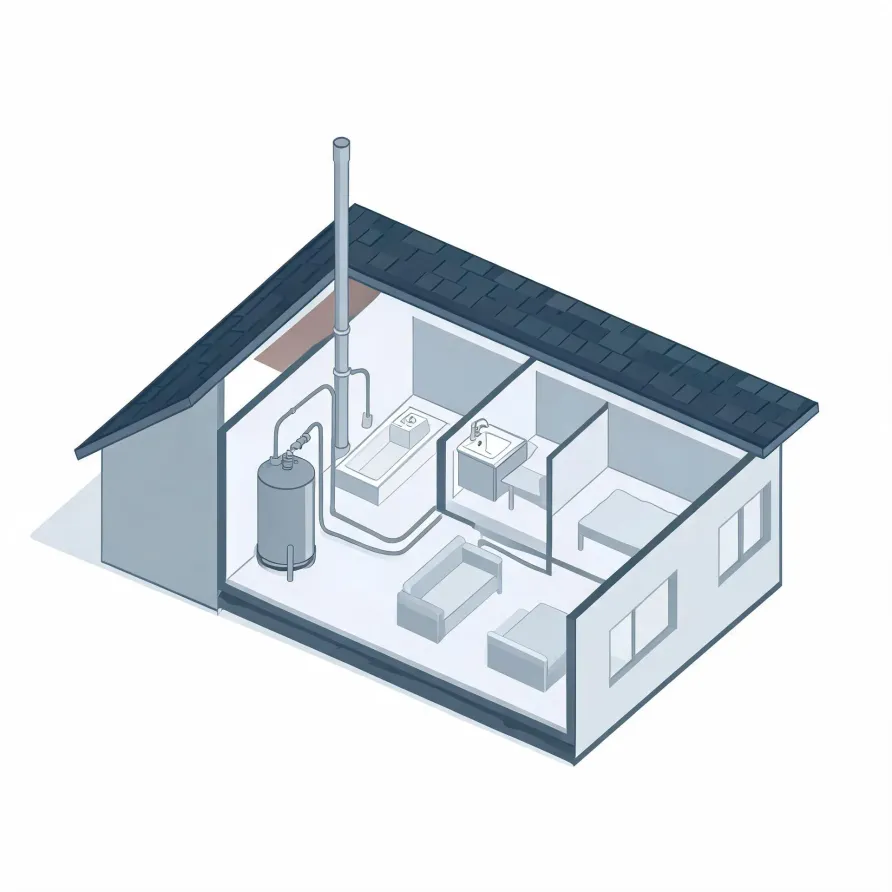
The tank is what most homeowners recognize: a large insulated cylinder that sits in a utility room, basement, or garage and holds the supply of heated water. Inside it, either a gas burner at the base or electric heating elements work against a thermostat to bring stored water to the set temperature. When the tank itself, the thermostat, or those heating elements are misbehaving, a contractor starts here.
At the top of the tank, a pressure relief valve guards against dangerous pressure buildup, and the anode rod suspended inside slows corrosion of the tank walls. The inlet and outlet connections carry cold water in and hot water out to the rest of the house. A contractor checks the valve, the rod, and those connections because each one fails in ways that show up as leaks, rumbling, or a loss of hot water.
The drawing shows the general layout of a water heater system, and a licensed contractor determines which parts and conditions apply to the specific unit in your home.
Get matched in Douglas CountyDouglas County, Minnesota, by the numbers
99 severe weather events were recorded in Douglas County, Minnesota between 2015 and 2024.
NOAA National Centers for Environmental Information, Storm Events Database, bulk CSV export, events 2015-01-01 through 2024-12-31.Half the homes in Douglas County, Minnesota were built in 1986 or earlier (2020-2024 ACS 5-year).
U.S. Census Bureau, 2020-2024 American Community Survey 5-Year EstimatesDouglas County, Minnesota holds 22,332 housing units (2020-2024 ACS 5-year).
U.S. Census Bureau, 2020-2024 American Community Survey 5-Year EstimatesOwners occupy 76.5% of the occupied homes in Douglas County, Minnesota (2020-2024 ACS 5-year).
U.S. Census Bureau, 2020-2024 American Community Survey 5-Year EstimatesCodes & Standards Governing Water Heater Repair in Douglas County, Minnesota2 sourced rules and standards
Licensing and Legal Requirements in Douglas County, Minnesota
Minnesota defines a mechanical contractor as a business that installs, repairs or maintains heating, ventilating, cooling or refrigeration systems — the definition that carries the exemption from the residential contractor licence.
Minnesota's residential contractor licence does not reach HVAC work: the licensing section carries its own exemption list, and a mechanical contractor is exempt from the licence requirement by name.
Severe Weather Events in Douglas County
Extreme weather puts direct stress on water heaters, forcing them to work harder and recover faster than they would under mild conditions. How often that stress hits Douglas County shapes how much wear local equipment accumulates, which is why the pattern here matters for repair decisions.
99 severe weather events, 2015–2024. Source: NOAA National Centers for Environmental Information, Storm Events Database.