Tell us about the job
Takes about a minute. No obligation.

A contractor quoting a water heater repair in Waseca County starts with the unit itself: how old it is, how it was installed, and which components are showing wear. 96 severe weather events were recorded in Waseca County, Minnesota between 2015 and 2024. At roughly the national midpoint, that record means severe weather is an occasional fact of life here rather than a constant mechanical burden. A sediment-choked tank, a failing anode rod, or a worn heating element will trace back to years of use and fitment choices, and the weather is seldom what a contractor points to when those parts give out.
A water heater old enough to belong to this housing stock draws replacement parts from a supply chain that has already started to move past it. Half the homes in Waseca County, Minnesota were built in 1970 or earlier (2020-2024 ACS 5-year). When a contractor opens a unit in a house that age, the diagnostic question settles quickly. What takes longer is whether the part the system actually needs is still in production or has to be sourced from shrinking secondary stock. That gap between what the unit requires and what the supply chain still carries is where repair jobs in this county get complicated.
The Parts of a Water Heater a Contractor Checks During a Repair
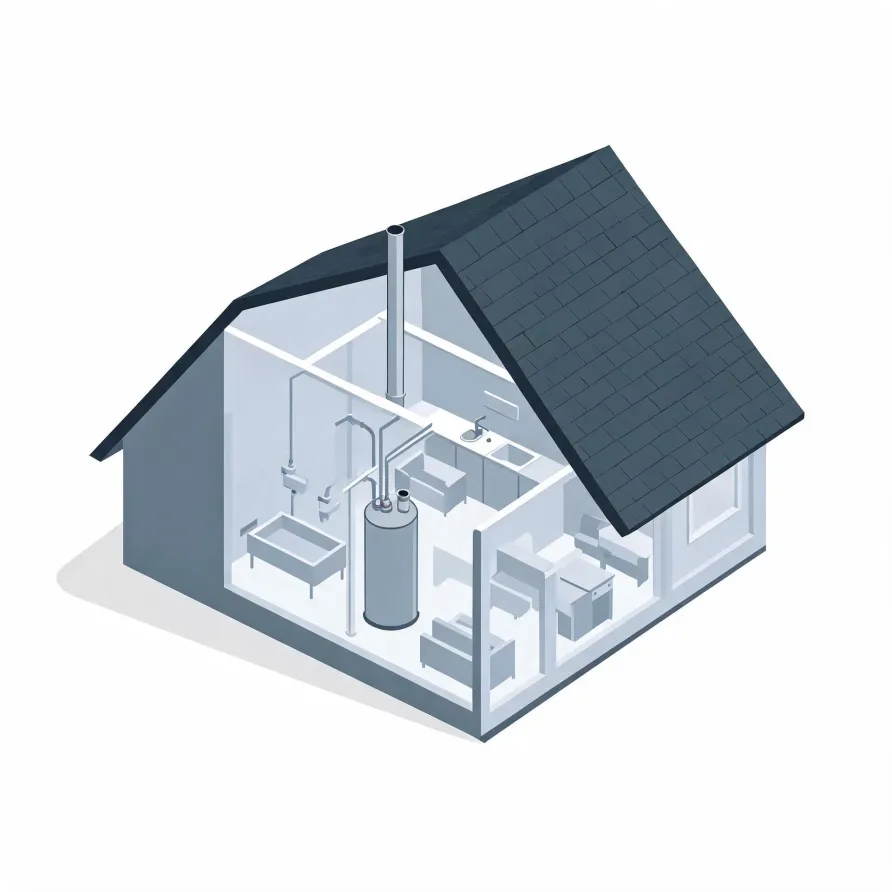
The tank is the piece a homeowner notices first, a large insulated vessel that sits in a utility room, basement, or garage and holds water at a set temperature around the clock. Attached to it are the dip tube, which directs cold water to the bottom, and the anode rod, which runs through the tank and slows corrosion from the inside. When either fails, the symptoms show up in the water itself.
The burner assembly or heating element sits at the base or inside the tank depending on whether the unit runs on gas or electricity, and the thermostat connects to it to regulate temperature. A pressure relief valve mounts on the side and opens if pressure climbs too high. The flue or exhaust vent runs from the top of a gas unit out through the wall or roof.
The drawing shows a typical water heater layout, and a licensed contractor will assess which components apply to the specific unit and installation in your home.
Get matched in Waseca CountyWaseca County, by the numbers
96 severe weather events were recorded in Waseca County, Minnesota between 2015 and 2024.
NOAA National Centers for Environmental Information, Storm Events Database, bulk CSV export, events 2015-01-01 through 2024-12-31.Half the homes in Waseca County, Minnesota were built in 1970 or earlier (2020-2024 ACS 5-year).
U.S. Census Bureau, 2020-2024 American Community Survey 5-Year EstimatesWaseca County, Minnesota holds 7,922 housing units (2020-2024 ACS 5-year).
U.S. Census Bureau, 2020-2024 American Community Survey 5-Year EstimatesOwners occupy 80.7% of the occupied homes in Waseca County, Minnesota (2020-2024 ACS 5-year).
U.S. Census Bureau, 2020-2024 American Community Survey 5-Year EstimatesWater Heater Repair Rules & Standards on the Books for Waseca County, Minnesota2 sourced regulations and codes
Licensing and Legal Requirements in Waseca County, Minnesota
Minnesota defines a mechanical contractor as a business that installs, repairs or maintains heating, ventilating, cooling or refrigeration systems — the definition that carries the exemption from the residential contractor licence.
Minnesota's residential contractor licence does not reach HVAC work: the licensing section carries its own exemption list, and a mechanical contractor is exempt from the licence requirement by name.
Severe Weather Events in Waseca County
Extreme weather puts real strain on water heaters, forcing them to work harder and wearing components down faster. How much of that pressure a unit faces depends on what the local climate actually delivers.
96 severe weather events, 2015–2024. Source: NOAA National Centers for Environmental Information, Storm Events Database.