Tell us about the job
Takes about a minute. No obligation.

A water heater in this county has not been sitting in a mild, uneventful climate. 130 severe weather events were recorded in Mower County, Minnesota between 2015 and 2024. At that rate, severe weather is a standing condition rather than an occasional disruption, and it shapes what a licensed contractor finds when they open a failing unit. Sediment buildup, pressure-relief stress, and tank fatigue all accumulate faster under that kind of sustained load. A contractor working a repair here has to establish how much of the damage traces to weather-driven wear before they can give a repair scope that holds.
Plumbing and mechanical systems in a house this old have been replaced piecemeal across multiple owners, which means the unit a contractor opens may be several generations removed from what the house started with. Half the homes in Mower County, Minnesota were built in 1958 or earlier (2020-2024 ACS 5-year). A water heater that old in origin is not the norm in the county's stock today, but the repair scope on any given call still depends on what that specific unit turns out to be once it is open: the model, the parts it takes, and whether those parts are still made. A discontinued heating element or a proprietary valve assembly changes the call from a repair to a replacement, and that determination comes from what is inside the unit, not from anything visible before the work starts.
The Parts of a Water Heater a Contractor Checks During a Repair
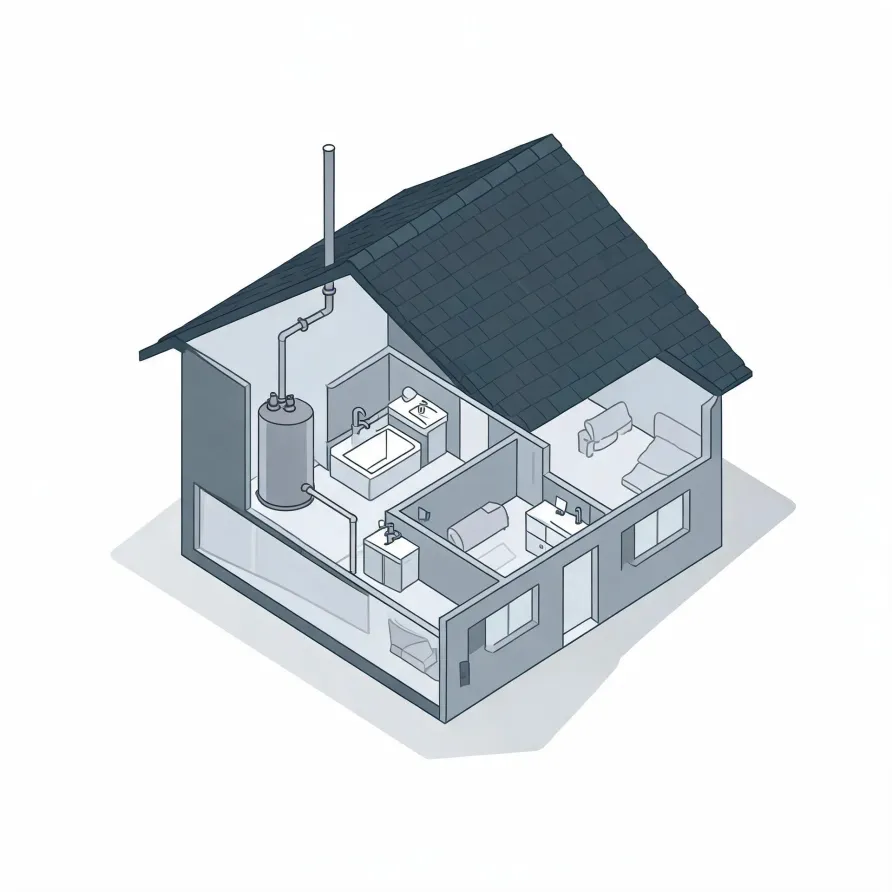
The tank is what most homeowners picture first: a large insulated cylinder that sits in a utility closet, basement, or garage and holds a standing supply of hot water. Attached to it are the inlet and outlet pipes, which bring cold water in and send heated water to every tap in the house.
The heating elements or burner assembly sit inside or beneath the tank and are the parts a contractor reaches first when a unit stops producing hot water. The pressure relief valve mounts on the tank's side as a safety device, and the anode rod runs down through the tank's interior to slow corrosion of the tank wall.
The drawing shows a typical water heater layout, and a licensed contractor determines which parts apply and what the actual condition is in your home.
Get matched in Mower CountyMower County, by the numbers
130 severe weather events were recorded in Mower County, Minnesota between 2015 and 2024.
NOAA National Centers for Environmental Information, Storm Events Database, bulk CSV export, events 2015-01-01 through 2024-12-31.Half the homes in Mower County, Minnesota were built in 1958 or earlier (2020-2024 ACS 5-year).
U.S. Census Bureau, 2020-2024 American Community Survey 5-Year EstimatesMower County, Minnesota holds 17,014 housing units (2020-2024 ACS 5-year).
U.S. Census Bureau, 2020-2024 American Community Survey 5-Year EstimatesOwners occupy 77.6% of the occupied homes in Mower County, Minnesota (2020-2024 ACS 5-year).
U.S. Census Bureau, 2020-2024 American Community Survey 5-Year EstimatesCodes & Standards Governing Water Heater Repair in Mower County, Minnesota2 sourced rules and standards
What Mower County, Minnesota Requires for HVAC Repair
Minnesota defines a mechanical contractor as a business that installs, repairs or maintains heating, ventilating, cooling or refrigeration systems — the definition that carries the exemption from the residential contractor licence.
Minnesota's residential contractor licence does not reach HVAC work: the licensing section carries its own exemption list, and a mechanical contractor is exempt from the licence requirement by name.
Severe Weather Events in Mower County
Extreme weather puts real stress on water heaters, forcing them to work harder and wear faster. How much of that pressure a unit faces depends on where it sits, which makes local weather history a practical part of understanding repair demand in this area.
130 severe weather events, 2015–2024. Source: NOAA National Centers for Environmental Information, Storm Events Database.